@tawaship/pixi-animate-container - v3.1.0
pixi-animate-container
"pixi-animate-container" is a plugin for using content created by Adobe Animate with "pixi.js".

Overview
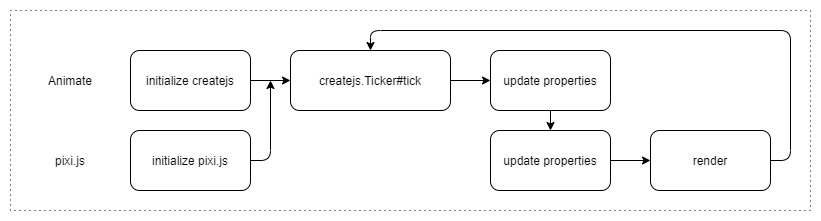
Each original (simplified) flow
-
createjs contents created with Adobe Animate

-
pixi.js contents

Flow to be realized
Supported version
- Content published for HTML5 Canvas by Adobe Animate 24.0 (the samples and the checks use content published by it)
- pixi.js 5.3.x
I have not confirmed the operation on other versions.
Setup
NPM
npm install --save pixi.js @tawaship/pixi-animate-container@3.1.0
import * as PIXI from 'pixi.js';
import * as PixiAnimate from '@tawaship/pixi-animate-container';
Browser
git clone https://github.com/tawaship/pixi-animate-container
<script src="https://code.createjs.com/1.0.0/createjs.min.js"></script>
<script src="https://cdnjs.cloudflare.com/ajax/libs/pixi.js/5.3.2/pixi.min.js"></script>
<script src="/path/to/dist/pixi-animate-container.min.js"></script>
<script src="[your content].js"></script>
Usage
For browsers, this module is stored in the namespace "PIXI.animate".
const app = new PIXI.Application();
PIXI.animate.loadAssetAsync([{
id: "[conposition id]", // "lib.properties.id" in Animate content.
basepath: "[content directory path]", // Directory path of Animate content.
options: {
crossOrigin: false
}
}]).then(function(lib) {
// If you load multiple contents, the argument "lib" will be an array and the "lib" of each content will be stored in order.
class Root extends PIXI.animate.Container {
constructor() {
super();
app.ticker.add(this.handleTick, this);
this.addCreatejs(new lib.game()); // The class you want to use.
}
}
app.stage.addChild(new Root());
document.body.appendChild(app.view);
});
See here for complete options for PIXI.animate.loadAssetAsync.
Supported features
What plays, sorted by how far it is confirmed. "Checked" means that the content is played frame by frame next to CreateJS itself, and what PixiJS is given to draw (positions, matrices, visibility, masks, blend modes, fills) is compared with what CreateJS would draw, after every frame and at every point PixiJS may render; the samples (https://tawaship.github.io/pixi-animate-container/samples/) show the same content played by this package and by CreateJS.
Supported
| Feature | Notes |
|---|---|
Timelines: independent / synched / single frame clips, loops, labels, gotoAndPlay / gotoAndStop, play / stop |
A goto made between frames (from a click handler or another ticker callback) is drawn at once |
| Frame scripts | Run at their frame, in the same order as CreateJS |
| Classic and motion tweens, motion guides, easing | |
| Rotation and skew | Drawn as Animate's HTML5 Canvas output draws them, also when both are set |
| Shapes with solid fills and strokes | |
| Bitmap fills (from an image or a sprite sheet frame) | The image is always repeated, which is what published content uses |
| Gradient fills and strokes (linear and radial) | Outside the gradient the end colors continue, as in CreateJS |
| Bitmaps and sprite sheets (one or several sheets) | |
| Masks, tweened masks, masks that are taken off | |
Color effects published as createjs.ColorFilter, and their tweens |
Drawn with a PIXI.filters.ColorMatrixFilter |
Blend modes: add (lighter), multiply, screen |
Switching them on and off, also on a shape, bitmap or text, as CreateJS draws them |
Buttons (ButtonHelper) and mouse events (mousedown, pressmove, pressup, click, rollover, rollout) |
Listened to with on / addEventListener on the CreateJS instance; PixiJS's pointer events are used underneath |
| Frame rate | Content plays at the frame rate it was published with, whatever the display's rate; createjsSmooth (on by default) keeps it even when the time between frames varies; createjsSpeed changes the speed |
Sound (playSound in frame scripts) |
With options: { useSound: true } in loadAssetAsync; played by CreateJS's Sound |
Probably works
| Feature | What is not confirmed |
|---|---|
| Dynamic text | Font, color, alignment, line height and width are passed on, and lines are broken by PixiJS's word wrap, which can break them at other places than CreateJS. textBaseline other than the default and outline are not drawn. A lineHeight of 0 (the default) uses PixiJS's line spacing, where CreateJS uses 1.2 times the width of "M" |
Playing a symbol other than the published root (new lib.Symbol() added with addCreatejs) |
Plays as a root of its own. Not compared with CreateJS frame by frame; the samples page can play any symbol of a sample |
cache() and filter caches |
CreateJS's cache is made but not used for drawing: color effects are drawn without it, and a blend mode on a cached clip applies to each object in it rather than to the cached image as a whole (they differ where the objects overlap) |
regX / regY of a bitmap or sprite |
Not covered by the published samples |
| A mask whose shape is empty (not null) | Not covered by the published samples; CreateJS does not clip with it, and this package may clip everything |
Not supported
| Feature | What happens |
|---|---|
| Blend modes other than add, multiply and screen (darken, lighten, overlay, hard light, difference and so on) | Drawn as the blend mode of the parent (PixiJS's WebGL renderer does not have them) |
| Filters other than color effects (blur, glow, drop shadow and so on) | Not drawn |
Bitmap strokes (beginBitmapStroke) |
Not drawn |
no-repeat and the other repetitions of a bitmap fill |
Drawn repeated |
Sprite sheet animations playing on their own (new Sprite(sheet, frame), a sprite's own framerate) |
A sprite shows the frame its timeline goes to (as published content uses sprites) |
Content that uses the Animate camera ("Advanced Layers") has not been checked.
Using with TypeScript
The full createjs 1.0 API is typed (via @tawaship/createjs-module), so
TypeScript checks every call against the real createjs surface. New type
errors on code that used to compile against an untyped createjs are the
checker catching a real mismatch, not a bug in this package.
Named child instances (this.a and friends) are stamped onto published
symbols at runtime by Adobe Animate's output, so no type definition can know
their names. CreatejsMovieClip therefore carries a string index signature:
any undeclared member resolves as any, so named instances can be referenced
directly with no per-content setup. Declared members are unaffected —
currentFrame is still number, and wrong-typed writes to declared members
still error. Note that this works on values typed as CreatejsMovieClip (or
a subclass); a union type only allows members that exist on every branch.
If you want named instances checked instead of any, declare them on your
own class — declare emits no code, so the runtime object is untouched, and
everything reached through the declared name stays fully typed:
import { CreatejsMovieClip } from '@tawaship/pixi-animate-container';
class Game extends CreatejsMovieClip {
declare a: CreatejsMovieClip; // named instance from the Animate timeline
}
Prefer the wrapper classes exported by this package (CreatejsMovieClip,
CreatejsSprite, ...) in your own type annotations. They are subtypes of the
corresponding createjs.* classes, so they fit anywhere the createjs API
expects one.
The typed createjs runtime (with the wrapper classes installed) is also re-exported, so one import serves both:
import { createjs, CreatejsMovieClip } from '@tawaship/pixi-animate-container';
const tween = createjs.Tween.get(target);
mask, filters, compositeOperation and Shape.graphics are typed
nullable, matching the documented createjs runtime (their default is null,
and assigning null to mask is how a mask is cleared).
Claude Code skills
The package comes with skills for Claude Code (Anthropic's AI coding tool) in dist-skills/: pixi-animate-container-guide, which tells it how to load and play Animate content with this package. To let Claude Code use them in your project, copy them into the project's .claude/skills/:
mkdir -p .claude/skills
cp -r node_modules/@tawaship/pixi-animate-container/dist-skills/* .claude/skills/
Copy them again after updating the package: each skill describes the version it comes with, and tells Claude Code to follow the type definitions in node_modules when the installed version is another one.
Change log
3.1.0
- Added:
createjsSmooth(defaulttrue) on the container. EachhandleTickused to play the whole frames owed by thedeltavalues added up; when the content's frame rate divides the display's (60 fps content on a 60 Hz display), the small jitter ofdeltathen played no frame on one call and two on the next, which made the animation uneven. WithcreatejsSmooththe frames follow a steady clock kept in step with the real time, so the playing stays even. The frames played and their order are unchanged; set it tofalsefor the previous pacing. - Added: Claude Code skills in
dist-skills/, published with the package (see "Claude Code skills"). - Changed: a
createjsSpeedbelow0(orNaN) plays as0. The content pauses and resumes as soon as the speed is set back (frames cannot be played backwards).createjsSpeedstill reads back the value you set. - Fixed: what pixi.js draws now matches what createjs would draw at that
moment, whenever pixi.js renders — not only right after
handleTick. The container brings its content up to date right before each render, so:- after
gotoAndPlay()/gotoAndStop()called between frames (for example from another ticker callback or a click handler), the next render shows the new frame correctly. Previously, objects appearing for the first time on that frame were drawn once at their default position, rotation and alpha, and graphic (synched) symbols inside showed their previous frame - values you write to createjs instances after
handleTick(instance.x = 100) are drawn in the same display frame instead of one frame later - content added with
addCreatejsis drawn correctly even if a render comes before its firsthandleTick
- after
- Fixed: a value written to an instance's pixi node (
instance.pixi.x = 100) stays until the timeline writes that property again, as in 2.x (3.0.x lost it on the next tick). The createjs instance keeps its own value (instance.xstill reads what createjs wrote), as in 2.x. - Changed: the display properties (
x,y,scaleX,scaleY,rotation,skewX,skewY,regX,regY,alpha,visible) are accessors on the class prototypes again, as in 2.x: a value written on the createjs side is passed to the pixi node at once, soinstance.pixi.*read from a frame script is current. They are enumerable (for...inlists them) but are not own properties, soObject.keys()/JSON.stringify()of an instance do not include them._offstays a plain property.compositeOperationis an accessor on every display object class (it was on MovieClip only). - Fixed: objects that are both rotated and skewed are drawn the way the
browser output of Animate (createjs) draws them. The values of
pixi.rotation/pixi.skeware unchanged. - Fixed:
compositeOperationis drawn as createjs draws it. An object draws with its own value, or else its nearest ancestor's, so taking a value off (undefined/null) goes back to the inherited one; 2.x and 3.0.x kept drawing the value that was taken off, and a change made after a shape was first drawn did not show. The value of a Shape, Bitmap, Sprite or Text is drawn as well (it was ignored), andsource-overdraws normally inside a blended clip. - Fixed: a Shape given new
graphicsdraws only them (the previous graphics stayed drawn as well, unless the shape was used as a mask). - Added: bitmap fills (
beginBitmapFill/bf, which Animate publishes for shapes filled with a bitmap, from an image or a sprite sheet frame) are drawn. The image is always repeated, which is what published content uses. Bitmap strokes are not drawn. - Added: gradient fills and strokes (
beginLinearGradientFill/lf,beginRadialGradientFill/rf,beginLinearGradientStroke/ls,beginRadialGradientStroke/rs) are drawn, with the colors the browser's canvas paints; outside the gradient the end colors continue, as in createjs. Each gradient is drawn into a texture once and shared by the shapes that use it. - Fixed: an object marked
_offthat is on a display list is drawn, as in createjs. A shape used as a mask is no longer drawn itself, and a mask shape taken off withmask = nullis no longer left drawn in the pixi tree. - This release was implemented with Claude (Anthropic's AI assistant). Its correctness rests on verification rather than authorship: differential suites compare pure createjs, the previous release and the pixi tree after every tick and at every render point, and each change was confirmed to be caught by them when reverted.
3.0.1
- The full createjs 1.0 API is now typed: the wrapper classes extend the real
(typed) createjs classes and are true subtypes of them, so wrapper
instances fit every
createjs.*-typed parameter (addChild,localToLocal,hitArea, ...). See "Using with TypeScript" above. This completes the type strictness introduced in 3.0.0. - Fixed:
removeAllChildren()now reaches the Pixi mirror (the override was misspelledremoveAllChldren, so the correctly-spelled call bypassed it and left the Pixi children behind). - Fixed:
addChild/addChildAtwith multiple children now forward every child (previously only the first argument reached either tree). - Fixed:
CreatejsSprite.gotoAndStop()passes a realPIXI.Rectangleas the texture frame (previously a createjs rectangle was passed by reference and happened to work). - Changed:
CreatejsButtonHelperthrows an explicitTypeErrorwhentarget/hitAreaare not wrapper instances (previously it crashed at the same point with a property-accessTypeError). Valid Animate publish output is unaffected. - Added:
CreatejsButtonHelpersupports the 4-argument publish form. Animate publishes a button whose hit frame is empty asnew cjs.ButtonHelper(target, 0, 1, 1); the original then uses the target itself as the hit surface, and the wrapper now mirrors that (previously this form crashed during construction). - Changed: interaction bridging in
addEventListener/removeEventListenernow branches on the listener being a function; non-ButtonHelperobject listeners are no longer passed to the function-only bridge. - Removed unused internal types left over from the 2.x era:
ICreatejsColorFilterBase,ICreatejsColorFilterBaseConstructor,ICreatejsDisplayObjectBase,ICreatejsLabel,ICreatejsChildNode. - The typed createjs runtime is re-exported (
import { createjs } from '@tawaship/pixi-animate-container'), and the constructor-argument helper types (TCreatejsMovieClipConstructorArgsetc.) are now derived from the real createjs constructors instead of being maintained by hand. CreatejsMovieClipcarries a string index signature, so the named child instances stamped in by Animate publish output (this.aand friends) can be referenced without per-content declarations (they type asany; declared members keep their strict types). See "Using with TypeScript".TCreatejsObjectno longer includesCreatejsGraphics. The union's contract is "wraps a real createjs display object" (whataddCreatejsaccepts), and the realcreatejs.Graphicsis a drawing-command container, not a display object — it is reached throughshape.graphics, never placed on a display list. As a result, the EventDispatcher API (on/off/addEventListener, ...) is now usable through the union.- Fixed:
off()now also detaches the Pixi-side interaction bridge. The originaloffis a prototype alias ofremoveEventListener, which bypassed the wrapper's override — so removing an interaction listener (mousedown,click, ...) registered withon()left the Pixi-side listener behind: the handler kept firing on pointer input and the object stayedinteractive. Published content never removes listeners, so only hand-written code usingon()/off()was affected. - This release was implemented with Claude (Anthropic's AI assistant). Its correctness rests on verification rather than authorship: the same per-tick full-state differential suites as 3.0.0, plus a direct diff of the built output against v3.0.0 confirming the only runtime changes are the ones listed above.
3.0.0
-
Timeline ticking is now delegated to the original createjs traversal, so sibling frame scripts run in the same order as pure createjs (reverse walk over the live children array). Content that depends on order-sensitive sibling interactions (siblings sending the shared parent to different frames, reading each other's state, removing each other) now behaves exactly like genuine createjs. Content without such interactions is unaffected.
-
Instances removed from the display list in the middle of a tick are no longer processed once more in that tick.
-
instance.addEventListener("tick", handler)now works: tick events are delivered through the original createjs dispatch path. -
Display properties (
x,y,scaleX,scaleY,rotation,skewX,skewY,regX,regY,alpha,visible,_off) are plain data properties again, exactly as in original createjs, and are copied to the pixi mirror once per tick. Two consequences:- Reading
instance.pixi.*from inside a frame script returns the values synced at the end of the previous tick. Read the createjs-side properties (always current) from frame scripts instead. - Reading
_offbefore anything writes it returnsundefinedinstead offalse(equivalent in every boolean context).
- Reading
-
createjs.ColorFilterexposes its 8 color scalars as plain enumerable properties, exactly as in original createjs. -
Discontinued
name mixinCreatejsDisplayObject IMixinedCreatejsDisplayObject ICreatejsParam CreatejsMovieClip.updateForPixi updateDisplayObjectChildren -
TypeScript: the wrapper classes are typed against declared interfaces instead of
any, so member access outside the declared surface no longer compiles (e.g.mc.on(...), named timeline instances). 3.0.1 completes this with full createjs typings; see "Using with TypeScript". -
This release was implemented with Claude (Anthropic's AI assistant). Its correctness rests on verification rather than authorship: a per-tick full-state differential suite confirms equality with the previous release everywhere except the intended changes above, and equality with pure createjs including sibling-interaction content.
2.4.0
-
Discontinued
name class createjs.Stage CreatejsStage createjs.StageGL CreatejsStageGL -
Timeline advancement is now driven by delta time accumulation: each tick, delta time is converted to a frame count and
updateForPixi()is called once per elapsed frame.- With
createjsOverSpeedset totrue(default), the number of calls per tick can exceed one, allowing animation playback speed to be maintained in real time even when the PIXI.js frame rate drops.
- With
-
Fixed an issue where nested MovieClips could advance frames at slightly different timings due to independent time accumulation.
2.3.0
- Control of createjs animation speed
- Control of createjs custom frame event
endAnimation: reach the last framereachLabel: reach the labeled frame
2.1.0
- Supports compositeOperation (blendMode in pixi.js)
- lighter (
PIXI.BLEND_MODES.ADD) - multiply (
PIXI.BLEND_MODES.MULTIPLY) - screen (
PIXI.BLEND_MODES.SCREEN)
- lighter (
2.0.0
- Integrate core modules into source code
- Changed the method of linking with pixi.js ticker
- Supports sound playback
- Improving accuracy of interaction processing
1.0.0
-
Overrides
name class createjs.MovieClip CreatejsMovieClip